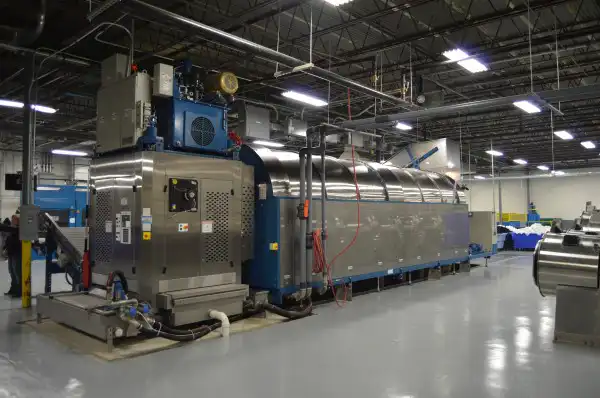
Expert Guide to Production: Tumbling and Conditioning Introduction
By Russell Macfarlane
The purpose of the drying operations is to reduce the moisture level remaining in the product and linens so that it may be processed effectively in succeeding operations.
Importance of Correct Moisture and Temperature
The drying and conditioning are of critical importance because good quality and high productivity of operations performed downstream are dependent on receiving the fabric with the optimum residual moisture and its correct temperature.
Risks of Overdrying and Underdrying
For items that are fully dried, the residual temperature should equal the ambient moisture level of the room. If the fabric is overdried, it will absorb moisture from the room and the time and energy used in over drying is wasted. Overdried fabric breaks off as lint and result in excessive fabric degradation. If the fabric is over dried, it may not pass through the folders correctly. If it is under dried and stored with any dampness, it will become mildewed.
Cooling and Fire Safety Considerations
Fully dried fabrics must also be cooled so it can be efficiently handled by workers bare hands and so the remaining heat does not cause spontaneous combustion to occur while in storage. Numerous plant fires have been attributed to the temporary storage of hot linen product compacted in a trolley under its own weight. Under these conditions it may continue to generate heat until spontaneous combustion takes place.
Conditioning for Further Processing
Conditioning, rather than fully drying, is sometimes used for items requiring subsequent processing - ironing or pressing. Residual moisture is critical if the residual moisture level is too low, the finish quality will be poor. This results in rejections, which must be rewet, extracted and conditioned again. If this is not done the inferior quality results in a dissatisfied customer. Synthetic blend garments must be cooled close to the ambient temperature to avoid setting wrinkles, which cannot be removed in a tunnel finisher.
Production Flow and Bottlenecks
The production time for drying is critical too. The drying operation links the washing and extraction operation to the finishing and folding operations. The drying operation must process its work in time as the washroom produces it not to create bottlenecks within the operation. It must provide fully dried or conditioned pieces for the finishing and folding departments as they are required. Work in progress storage is necessary on both the input and output ends of the drying department. Increased operating efficiency, including the efficiency of both management and machines, reduces the need for this work in progress storage.
Cost Considerations
The cost of drying is one of the major processing costs, and too many times it is not only uncontrolled, but also unknown and not measured. Equipment costs, labour costs, energy costs, linen costs, and maintenance costs are all major elements of the total cost.
Key Requirements for Good Operation
The requirements necessary to ensure good operation in the drying department are:
1. Good physical arrangement of the correct equipment.
2. Good maintenance.
3. Good operations management which requires accurate information comparing actual production performance to acceptable standards.